David Sulakauri
13 May – 20 June 2023
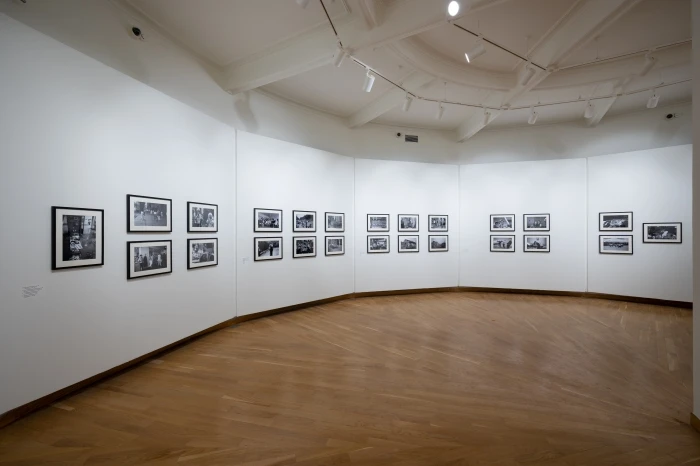
The exhibition How to Remember the 1980s presented a selection of photographs documenting the final decade of the Soviet Union and its gradual collapse, capturing the profound social and political transformations taking place in Georgia. As a direct witness to these events, David Sulakauri recorded the everyday realities unfolding around him, creating a visual chronicle that is both a testimony to Georgia’s recent history and a deeply personal record of one individual's life during a period of transition.
Born in Tbilisi in 1952, Sulakauri worked across a wide range of disciplines and moved within diverse professional circles, including science, cinema, theatre, visual art, rock music, and sport. His close involvement in these communities enabled him to document the cultural life of Tbilisi during the 1970s and 1980s from an insider’s perspective. His photographs reveal a growing desire for freedom and capture the social currents that ultimately led to Georgia’s independence.
Sulakauri graduated from the Faculty of Mechanics and Mathematics at Tbilisi State University in 1974 and later worked at the Andria Razmadze Mathematical Institute. He was an active member of the photographers’ collective Tvalsazrisi, dedicated to artistic photography. Passionate about rock music from the 1970s onward, he performed at unofficial concerts alongside Valeri Kocharov, Dato Popkhadze, and other musicians, embracing a musical culture that was closely associated with freedom and prohibited in the Soviet Union. He also played an important role in establishing karate culture in Georgia, contributing to the formation of the Georgian Karate Federation and, from 1988, to the creation of the Georgian National Olympic Committee, while also serving as a professional referee.
Following the dissolution of the Soviet Union, Sulakauri turned to graphic design and joined one of Georgia’s first private printing houses, Calamus Graphics Studio.
Sulakauri’s wide range of work and interests makes his photo archive especially valuable. Because he was part of the communities he photographed, he was able to record these events from the inside and offer a personal and authentic view of an important period in Georgia’s history.
Curators: Guram Tsibakhashvili, Mariam Tsikaridze, Nika Dumbadze



 TBC Bank 2026 - All Rights Reserved